Meta Ads Management: The Practical Guide We Hand to New Clients
Meta rewards the advertiser who feeds it clean signals and a steady stream of good creative. This is the meta ads management playbook we walk every new client through, from structure to scaling, written the way we actually run accounts.
Key takeaways
- Good meta ads management is mostly about three inputs: clean conversion signals, a simple structure and a steady creative pipeline.
- Consolidate. Fewer campaigns and ad sets with more budget each give the delivery system room to learn.
- Creative is now your targeting. Test concepts, not colour swaps, and give each test enough spend to mean something.
- Check pixel and Conversions API health before you judge any campaign. Broken signals make good ads look bad.
- Scale in steps, watch frequency and cost per result together, and refresh creative before fatigue shows up in the numbers.
01What meta ads management really involves in 2026
When a founder asks us what meta ads management actually involves, they usually expect an answer about audiences and bid settings. The honest answer is different. In the accounts we run, most of the performance comes from three things: the quality of the conversion signal Meta receives, how simple the account structure is, and how many genuinely different creative ideas we get in front of people each month. Targeting and bidding still matter, but far less than they did five years ago.
Meta’s delivery system has become very good at finding buyers on its own, provided you give it the right raw material. That shifts the job of whoever manages the account. You are less of a sniper choosing interests and more of an editor: deciding what the system should optimise for, what it gets to show, and when to step in because it has wandered off. That is the lens for everything in this guide, and it is the same lens our Meta ads management team uses on day one with a new client.
The weekly work, in plain terms
- Signals. Confirm purchases or leads are arriving in Events Manager at the right volume and with the right values.
- Structure. Keep campaigns consolidated so budget is not split into pieces too small to learn.
- Creative. Launch new concepts on a schedule, read the results, retire what is tired.
- Budget. Move money towards what works, in measured steps, and protect what is already profitable.
- Reporting. Reconcile Meta’s numbers with your store or CRM so decisions are based on real revenue.
02An account structure that gives Meta room to learn
The most common thing we inherit is fragmentation. Twelve campaigns, forty ad sets, each with a few pounds a day, each targeting a slightly different interest. It feels controlled. In practice, none of those ad sets gets enough conversions to leave the learning phase, and the account spends months in a permanent state of guessing.
Our default structure is deliberately boring. It fits most DTC brands, local service businesses and lead generation accounts with only small changes, and it is the backbone of the Facebook and Instagram ads management we run for clients across ecommerce and services.
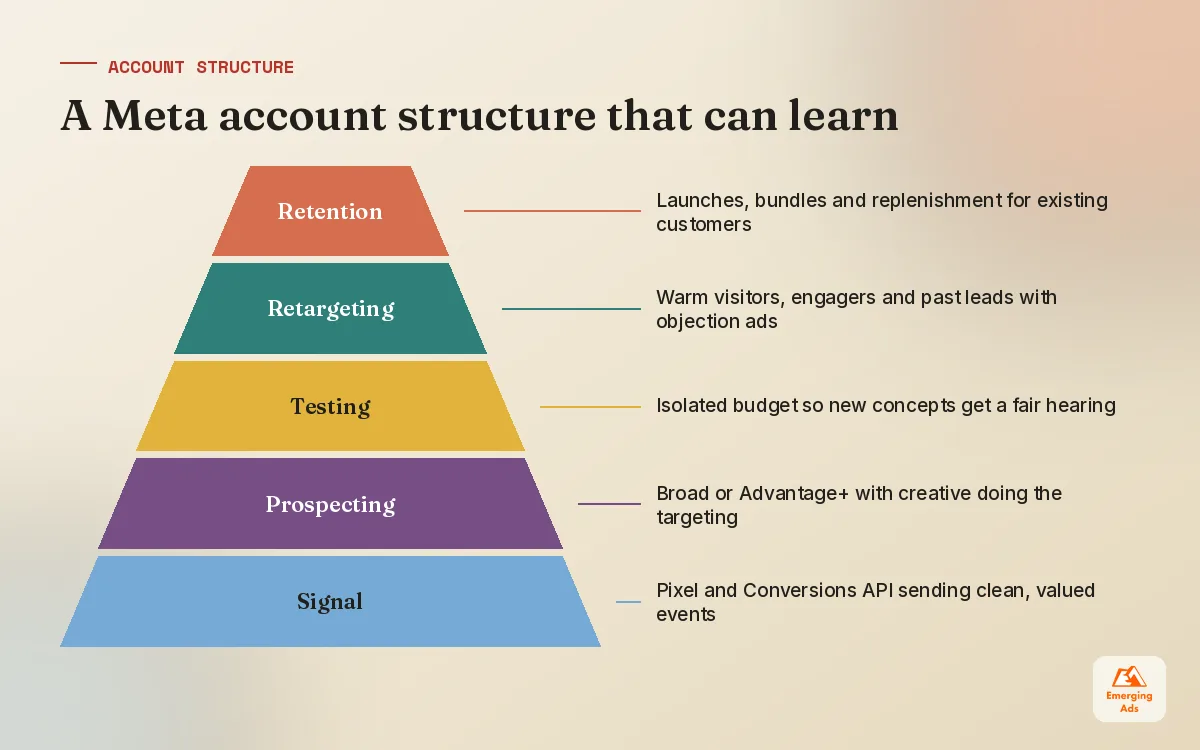
| Layer | What it does | Typical share of spend |
|---|---|---|
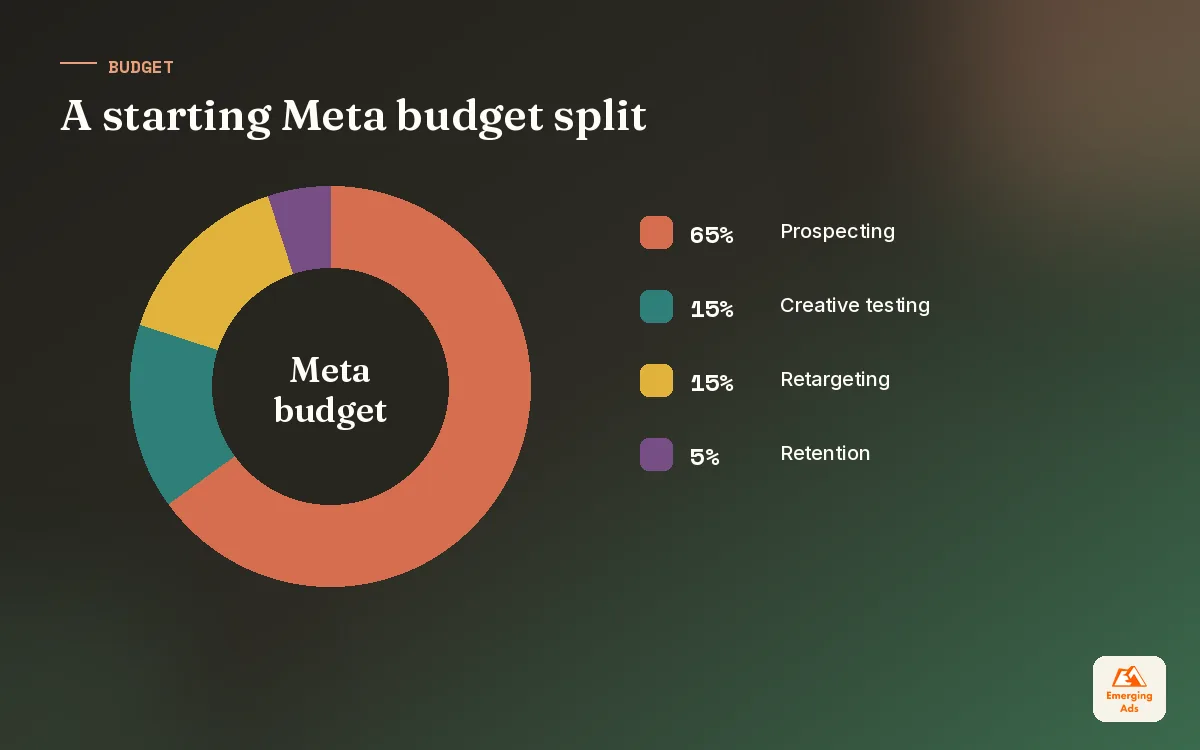
| Prospecting (broad or Advantage+) | Finds new buyers using creative as the main filter | The majority |
| Creative testing | Gives new concepts a fair, controlled hearing | A modest slice |
| Retargeting | Converts warm visitors, engagers and past leads | A smaller slice |
| Retention (ecommerce only) | Sells to existing customers: launches, bundles, replenishment | Optional, small |
The shares above are a starting point, not a rule. A brand with a big returning customer base might lean harder on retention. A new brand with almost no site traffic will find retargeting audiences too small to matter at first, so nearly everything goes to prospecting.
Campaign budget or ad set budget?
We use campaign level budgets (Advantage campaign budget) for prospecting, because we want Meta to push money to the best ad set. We often keep ad set budgets for creative testing, because the whole point of a test is to guarantee each concept gets its share. That is one of the few places where we deliberately override the algorithm.
Naming conventions that save hours
Name everything so a stranger could read the report. We use a pattern like objective, audience, offer, date for campaigns and concept, format, hook for ads. It sounds fussy. Six months later, when you want to know which hooks worked across forty ads, it is the difference between a five minute filter and an afternoon of guesswork.
03The creative testing system behind our meta ads management
If structure is the skeleton, creative is the engine. With broad targeting, the ad itself decides who stops scrolling, which means your creative is effectively your targeting. A skincare ad that opens with a dermatologist speaks to a different person than one that opens with a busy parent. Meta notices who engages and goes looking for more of them.
So the core of meta ads management, as we practise it, is a testing rhythm. Not random launches when someone has a spare afternoon, but a repeatable process that produces a few real winners every month.
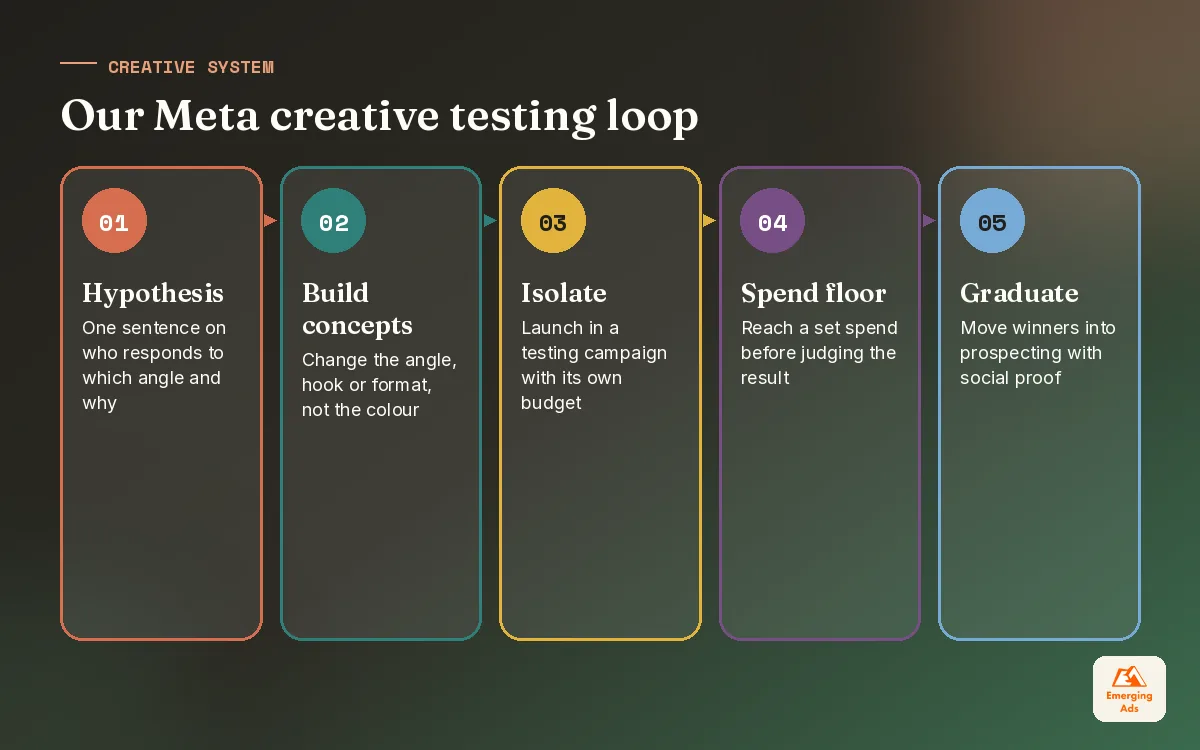
- Start with a hypothesis. Write one sentence: ‘Busy parents will respond to a time saving angle more than a price angle.’ If you cannot write the sentence, you are not testing, you are hoping.
- Build concepts, not variations. A new concept changes the angle, the hook or the format. A new background colour is a variation. Test concepts first, polish later.
- Isolate the test. Launch in the testing campaign with its own budget so a new ad is not smothered by an established winner.
- Give it enough spend. We set a floor, usually a multiple of the target cost per result, before we judge an ad. Killing ads after a day is the most expensive habit in paid social.
- Graduate winners. Move proven ads into prospecting as new ads (keeping the post ID where possible so social proof carries across).
What to read, and when
| Metric | What it tells you | When to trust it |
|---|---|---|
| Hook rate (3 second views / impressions) | Whether the first second stops the scroll | Early, after a few thousand impressions |
| Hold rate and CTR | Whether the story keeps attention and earns the click | After a few days of steady delivery |
| Cost per add to cart or lead | Whether interest turns into intent | Once you have a handful of events |
| Cost per purchase or qualified lead | Whether it actually makes money | Only after the spend floor is reached |
Reading metrics in that order stops you from making the classic mistake of killing a slow starter that had a strong hook, or scaling a clickbait ad that never sells. Most of the losers we retire fail at the first two rows, which is cheap to learn.
Your targeting lives in the first three seconds of the ad now. Test hooks like your budget depends on it, because it does.
04Advantage+ campaigns: when to hand over the keys
Advantage+ shopping and the wider Advantage+ settings ask you to give up control of audiences, placements and sometimes creative combinations in exchange for Meta’s own optimisation. Clients often ask whether they should switch everything over. Our answer depends on the account, and we set up Advantage+ campaigns differently for a mature store than for a brand still finding its first customers.
Where Advantage+ tends to do well
- Ecommerce accounts with a healthy, consistent flow of purchase events.
- Catalogues with many products where dynamic formats help match product to person.
- Brands with a deep bench of creative, so the system has plenty to choose from.
Where we hold back
- New pixels with very few conversions. The system has little to learn from.
- Lead generation where lead quality varies a lot and Meta cannot see which leads turn into sales.
- Accounts where existing customers make up much of the audience and the business cares specifically about new customer acquisition, unless you set up the existing customer controls carefully.
The pattern here mirrors what we see with Google’s automated formats. If you have read our Performance Max guide, the logic will feel familiar: automation amplifies whatever you feed it. Clean data and strong creative get amplified. Messy data and weak creative get amplified too.
05Audiences, retargeting and the role of first-party data
Broad targeting does the heavy lifting in most accounts we manage now, but audiences have not disappeared. They have changed jobs. Instead of telling Meta exactly who to reach, they give hints, exclude people you do not want to pay for, and power retargeting.
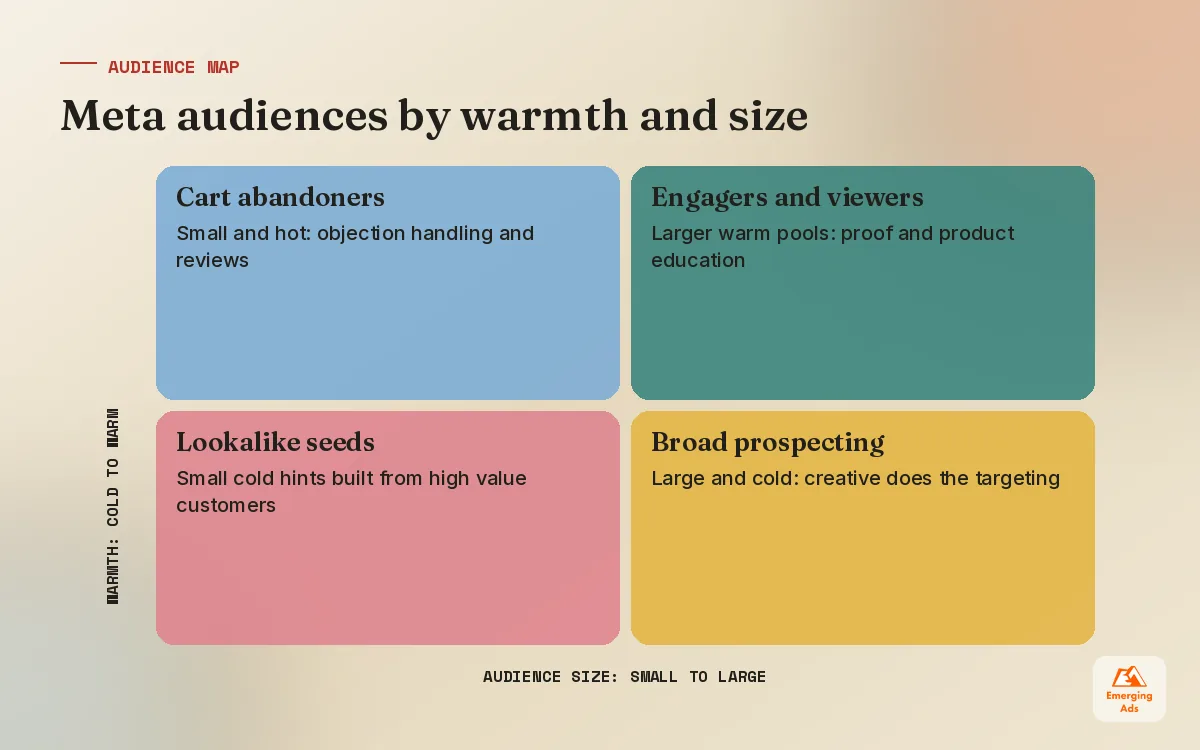
How we use each audience type
- Broad with suggestions. The default for prospecting. Age and location guardrails, with interests or lookalikes as suggestions rather than hard limits.
- Customer lists. Uploaded and refreshed regularly, used for exclusions in acquisition campaigns and for retention offers.
- Site visitors and engagers. The fuel for retargeting, split by how warm they are: product viewers, cart abandoners, and past leads who did not book.
- Lookalikes. Still useful as suggestions for newer accounts, especially seeded from high value customers rather than all customers.
Retargeting deserves its own creative. Someone who abandoned a basket has already seen your hero ad. Show them reviews, delivery details, a comparison or an answer to the objection that stopped them. Our Meta retargeting setups usually run three or four message sequences rather than one generic ‘come back’ ad.
For lead generation businesses, audience work is closely tied to the form. Instant forms are fast and cheap but can bring in low intent contacts. If you run Meta lead generation ads, add a qualifying question or two, and send lead status back to Meta so it learns which people actually become customers.
06Pixel and Conversions API health: the part nobody sees
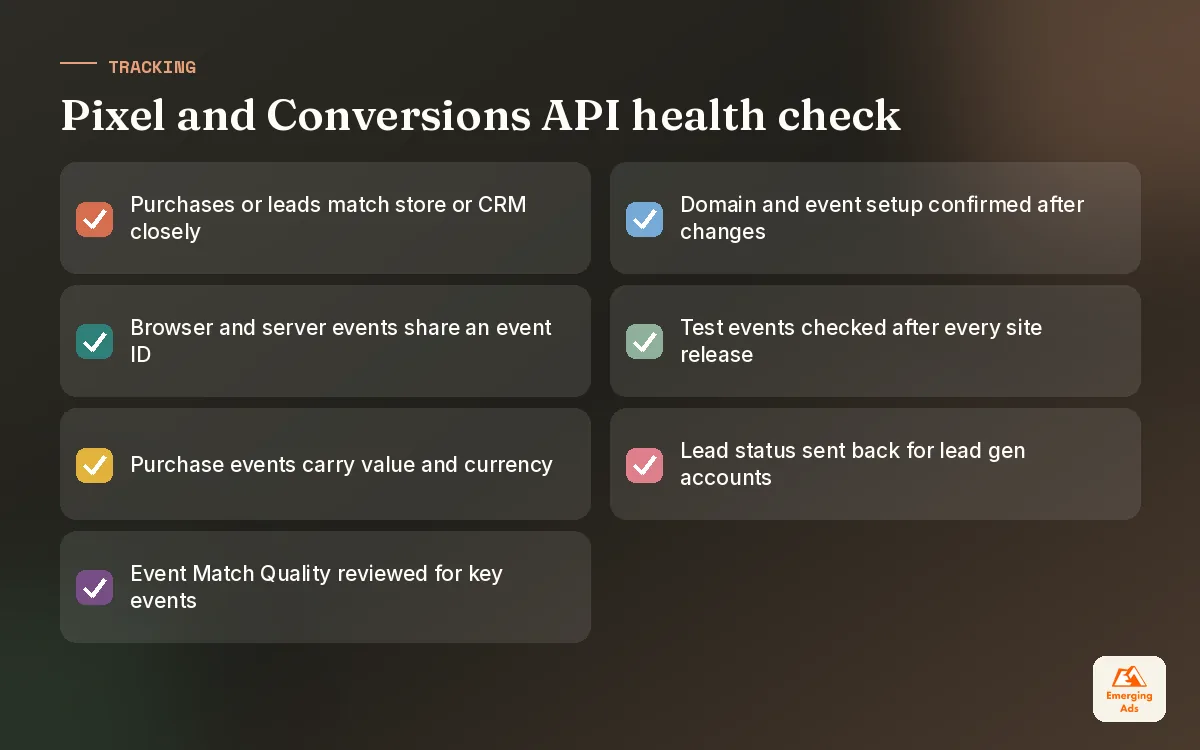
Every other part of meta ads management rests on this. Meta optimises towards the events it receives. If purchases are missing, doubled, or arriving without values, the system is learning from a distorted picture, and it will confidently spend your money on the wrong people.
Browser tracking alone misses a growing share of conversions because of ad blockers, privacy settings and short cookie lifetimes. The Conversions API sends events from your server as well, and with proper deduplication Meta counts each conversion once. In accounts we take over, a proper Meta pixel and Conversions API setup is often the single most valuable fix in the first month.
Signs your signal is broken
- Meta reports far more or far fewer purchases than your store shows for the same period.
- Event Match Quality in Events Manager is low for your key events.
- Purchase events arrive without value or currency, so value optimisation has nothing to work with.
- Browser and server events are both firing but without a shared event ID, so they are not deduplicated.
- Domain or event configuration was never completed after an iOS privacy change or a site rebuild.
None of this is glamorous. It is also the work most likely to be skipped by a busy in-house team, because it lives between marketing and development. If your numbers feel off, a structured Facebook ads audit will usually find the leak faster than another round of creative.
07How to scale Meta ads without breaking what works
Scaling is where good accounts get damaged. A campaign hits a great week, someone doubles the budget, the cost per result jumps, and the panic edits begin. Scaling well is mostly about patience and reading the right signals.
Vertical and horizontal scaling
| Approach | What it means | When we use it | Watch out for |
|---|---|---|---|
| Vertical | Raise the budget on a winning campaign | Stable results for a week or more | Big jumps can reset learning and spike costs |
| Horizontal | Add new ads, concepts or markets | When a campaign is saturating | Splitting budget too thin again |
| Creative-led | Feed winners with fresh variations of the same idea | When frequency is climbing | Recycling the same hook too long |
| Offer-led | New bundle, guarantee or lead magnet | When the ad is not the problem | Margin impact on ecommerce |
We raise budgets in measured steps and leave each change alone for several days before judging it. We would rather take a month to double spend profitably than a week to double it and spend the next month recovering.
For online stores, scaling is tightly connected to margin and average order value, not just return on ad spend. Our Meta ads for ecommerce work always starts by agreeing a break-even target with the client, so ‘scale’ means more profitable orders, not just more orders.
08Spotting creative fatigue before it costs you
Every ad wears out. The question is whether you notice early or late. Fatigue rarely arrives as a sudden cliff. It is a slow slide: the same people see the ad again and again, engagement drops, costs creep up, and by the time the cost per purchase looks bad you have already paid for weeks of decline.
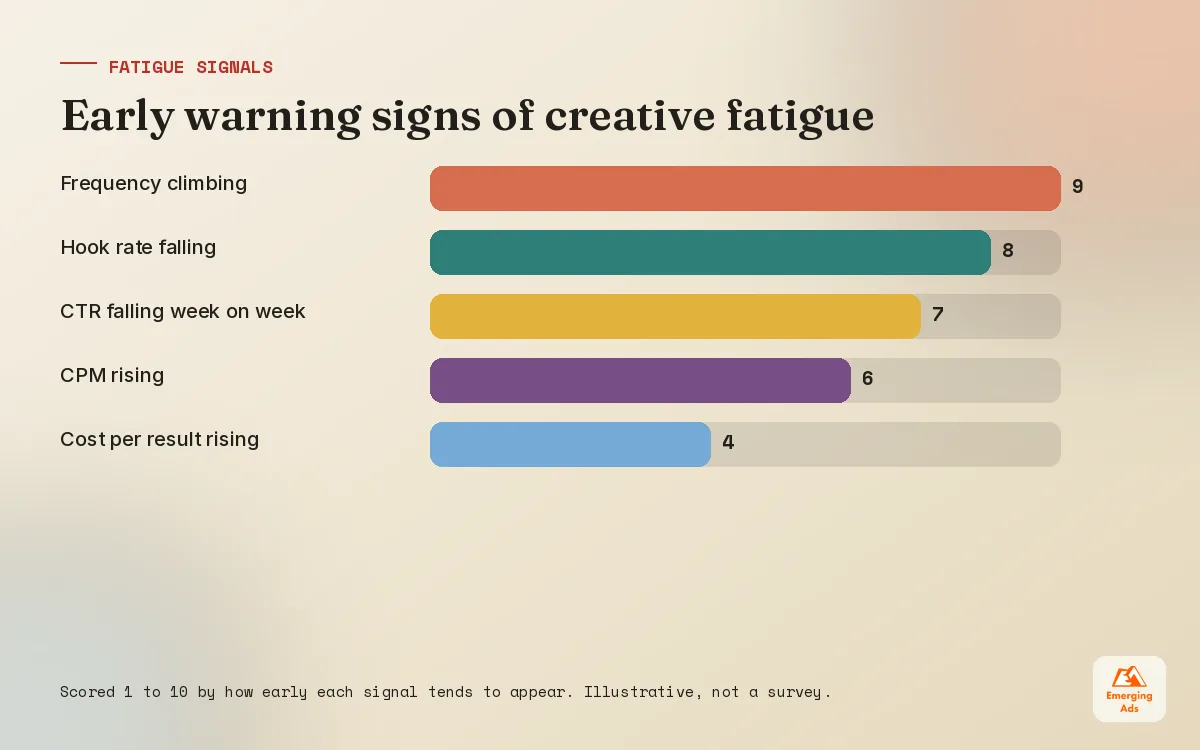
- Frequency climbing in prospecting while reach flattens.
- Hook rate and CTR falling week on week for the same ad.
- CPM rising without a seasonal reason such as a sale period.
- Comments turning stale, or the same few people interacting repeatedly.
The fix is almost never to switch the ad off and hope. We keep a pipeline of new concepts in testing so there is always something ready to replace a tiring winner. When a big winner fades, we try new hooks on the same body, new formats of the same idea, and new faces delivering the same message. That usually squeezes a lot more life out of a proven concept.
09Reporting, budgets and how Meta fits your wider ad mix
Meta’s in-platform reporting is useful for comparing ads against each other. It is less reliable as a verdict on whether the channel is profitable, because attribution windows and modelled conversions can flatter or understate results. We report on two levels: Meta’s own numbers for creative and audience decisions, and blended numbers from the store or CRM for business decisions.
Where Meta sits next to Google
For most clients, Meta creates demand and Google captures it. Someone sees a Reel, thinks about it for a few days, then searches your brand name. If you only judge Meta on last click, it will look weaker than it is, and your branded search will look stronger than it is. We cover how we run the search side in our Google Ads management guide, and we plan budgets across both platforms together rather than in separate silos.
If you are weighing up whether to bring this in-house or hand it to a specialist, have a look at how we work on the emergingadshq.com homepage. Either way, the checklist in this guide will tell you quickly whether your current meta ads management is doing the fundamentals well.
Frequently asked questions
Straight answers to what clients ask us most about meta ads management.
What does meta ads management include?
How much should I spend on Meta ads to start?
How many ads should be in an ad set?
How long should I wait before judging a new ad?
Is broad targeting really better than interest targeting?
Should I use Advantage+ shopping campaigns?
Do I need the Conversions API if I already have the pixel?
Why do Meta's numbers not match my Shopify or CRM figures?
How often should I refresh Meta ad creative?
What is the best way to scale a winning Meta campaign?
Can Meta ads work for lead generation and local businesses?
Is your Meta account spending more than it is learning?
We will look at your structure, creative pipeline and tracking side by side and tell you plainly what to fix first. No jargon, just a short list you can act on.
Book your free audit