Google Ads Management: The Practical Guide We Hand to New Clients
Good Google Ads management is not a burst of clever tweaks. It is a calm operating system: a clear structure, a weekly rhythm, honest reporting and the discipline to know when to leave a campaign alone. This is the version we walk every new client through.
Key takeaways
- Google Ads management is an operating system, not a list of tweaks: structure, rhythm, reporting and restraint.
- Build the account around how your business makes money, not around how many keywords you can find.
- A fixed weekly rhythm beats daily fiddling, because bidding needs stable data to learn from.
- Report on leads, sales and cost per acquisition first; clicks and impressions are context, not results.
- Step in when data says something has changed, not when a single day looks bad.
01What Google Ads management actually involves
When a founder asks us what Google Ads management really covers, they are usually expecting a list: keywords, bids, ad copy, maybe a monthly report. Those things matter, but they are the visible tip. The real work is running an account as a system, so that every change has a reason, every pound has a job and everyone involved knows what happens next. That is what separates an account that quietly improves for three years from one that lurches between panic and neglect.
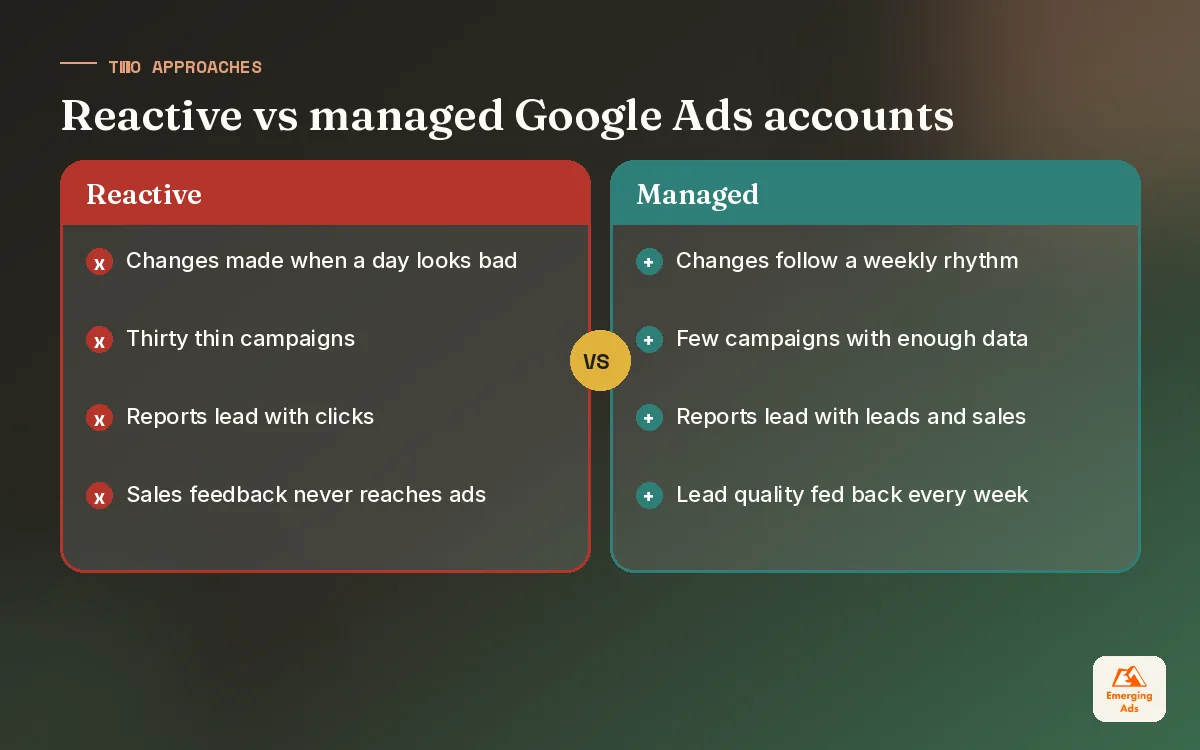
We have taken over hundreds of accounts from in-house teams, freelancers and other agencies. The pattern is remarkably consistent. The accounts that struggle rarely lack effort. They lack a shape. Campaigns were added whenever someone had an idea, conversion actions multiplied without anyone noticing, and changes were made on a Tuesday afternoon because a dashboard looked red. Nobody wrote anything down.
The four parts of the operating system
- Structure. How campaigns, ad groups and budgets map to the way your business earns money.
- Rhythm. A fixed weekly and monthly cadence of checks, so work happens on purpose rather than by mood.
- Ownership. A clear split of who decides, who does and who supplies information, including your sales team.
- Reporting and restraint. Numbers people read, and a rule set for when to intervene and when to wait.
Everything else in this guide hangs off those four parts. If you only remember one idea, make it this: the best-run accounts we see are not the busiest. They are the most deliberate.
02The account structure we build first
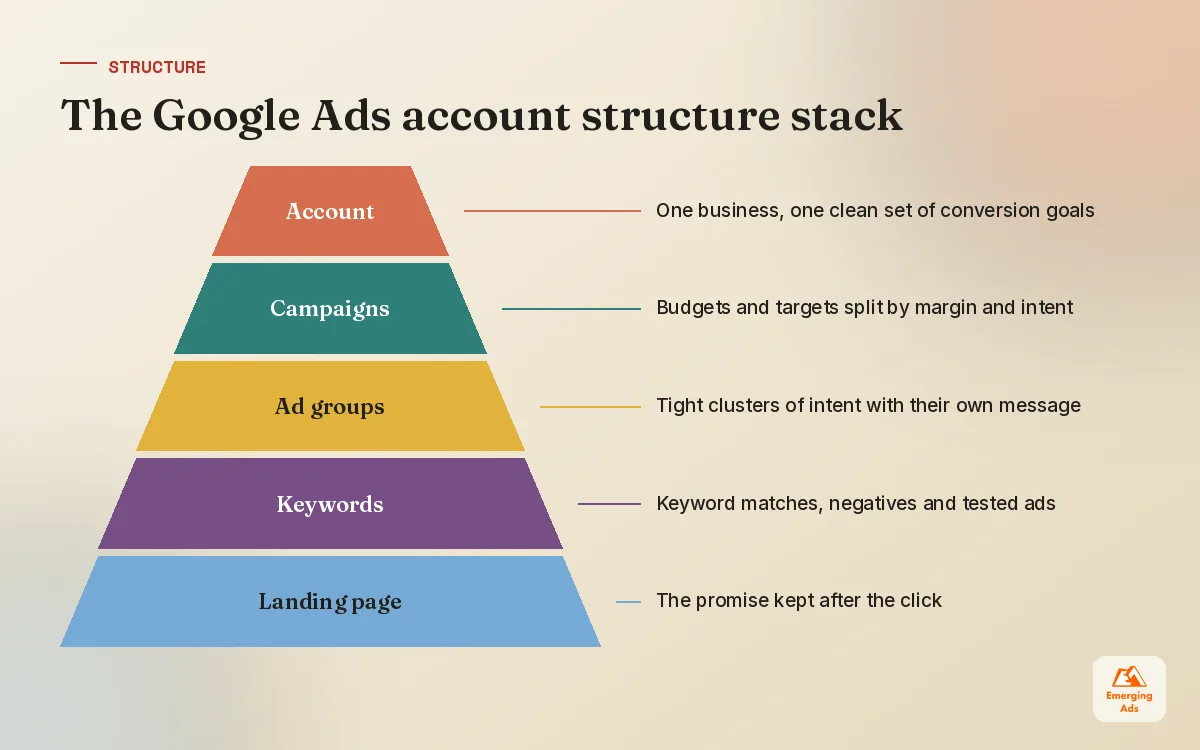
Structure is the part most people want to skip, because it feels like admin. It is actually where most of the long-term performance comes from. Google’s bidding systems learn at campaign level, budgets are set at campaign level, and reporting is easiest to read at campaign level. So your campaigns should mirror the decisions you want to make about money.
Split by margin and intent, not by keyword theme
A common inherited structure has thirty campaigns, one per keyword theme, each with a small budget and too little data to learn. We usually consolidate. A local plumbing firm, for example, might end up with one campaign for emergency jobs, one for planned installations, and one protecting the brand name. Three budgets, three clear goals, enough volume in each for smart bidding to work. An online retailer with very different margins across categories splits by margin band first, because a product that earns you twice as much deserves a different target.
| Layer | What it is for | Typical mistake we find |
|---|---|---|
| Account | One business, one set of conversion goals | Old conversion actions still counted as primary |
| Campaign | A budget and a bidding target you would defend | Too many campaigns splitting thin data |
| Ad group | A tight cluster of intent with its own message | Hundreds of loosely related keywords |
| Keywords and assets | The words and messages that match the intent | No negatives, ads written once and forgotten |
| Landing page | The promise kept after the click | Every ad sending traffic to the homepage |
If you are running Search, we pay particular attention to the ad group and landing page layers, because that is where relevance is won or lost. Our Google Search ads management work usually starts with rebuilding those two layers before anything else, and fresh keyword research tells us which intents deserve their own ad group.
Where Performance Max fits
Performance Max has a place in many accounts, especially ecommerce, but we treat it as one campaign type inside the structure, not the structure itself. It sits alongside Search and brand campaigns with its own budget and its own target, and we watch how it interacts with them. If you run an online store, our Performance Max management approach is built around that principle.
03The weekly Google Ads management rhythm
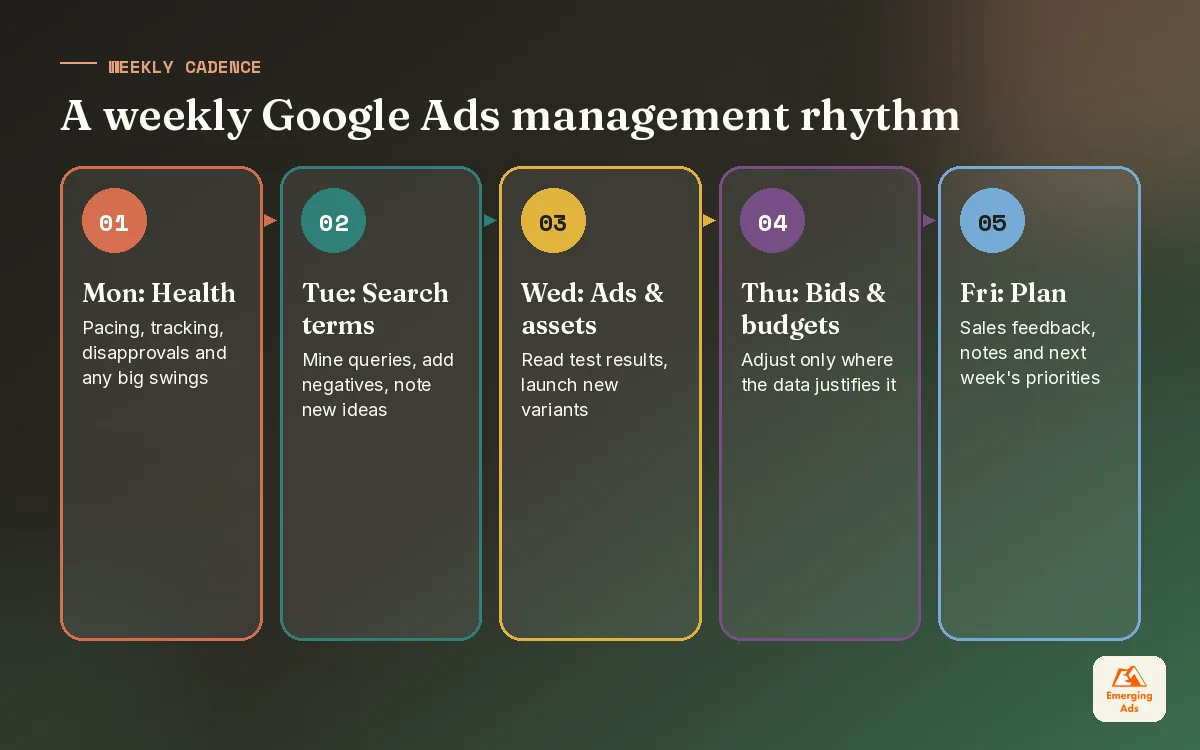
The single biggest change we make for most new clients is replacing ad hoc tinkering with a fixed rhythm. Smart bidding needs stable conditions to learn. Every time you change a target, pause a group of keywords or rewrite every ad at once, you reset part of that learning. A weekly rhythm protects the account from well-meaning interference, including our own.
What a normal week looks like
| Day | Focus | Time on a mid-sized account |
|---|---|---|
| Monday | Health check: spend pacing, tracking, disapprovals, big swings | 30 to 45 minutes |
| Tuesday | Search terms review and negative keywords | 45 to 60 minutes |
| Wednesday | Ads and assets: test results, new variants, landing page notes | 45 minutes |
| Thursday | Bids, budgets and targets: only where the data justifies it | 30 minutes |
| Friday | Notes, lead quality feedback from sales, plan for next week | 30 minutes |
Times are illustrative and scale with spend and complexity. The point is the order. Health comes first, because there is no sense optimising an account whose tracking broke over the weekend. Search terms come early because they are the richest source of new negatives and new ideas. Bids and budgets come late, after we understand what changed and why.
The monthly and quarterly layer
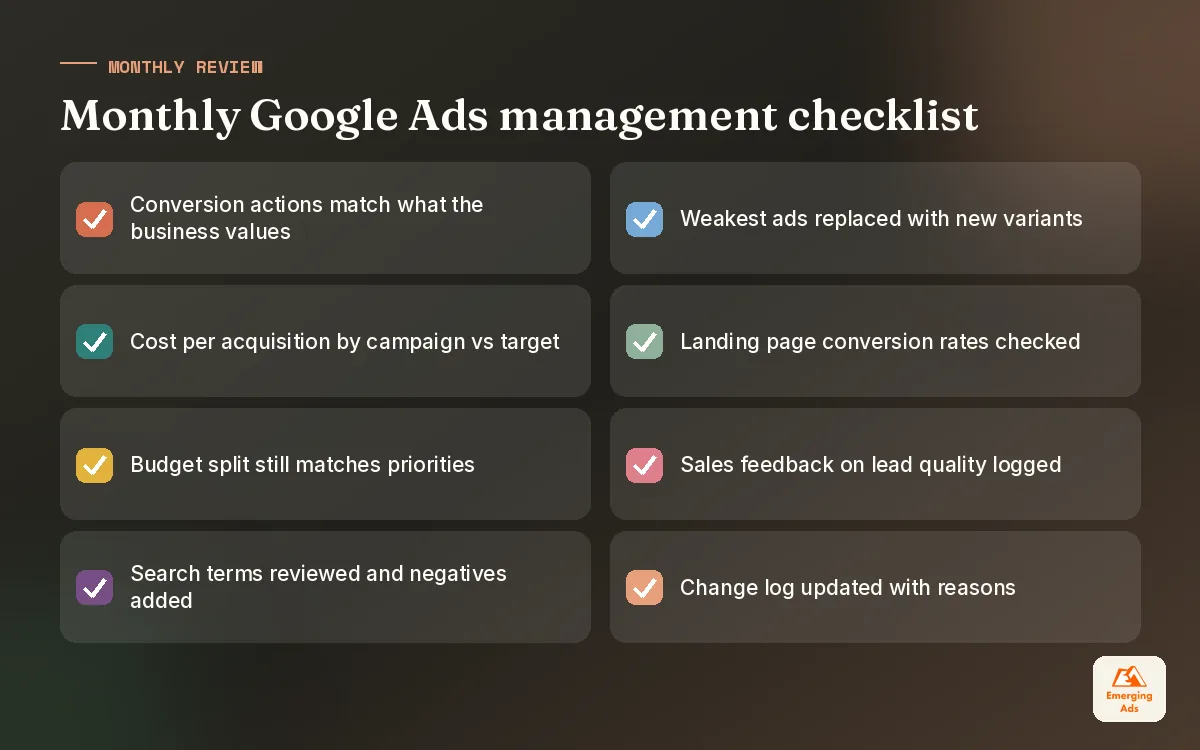
- Monthly: review cost per acquisition by campaign, check budget split against targets, refresh underperforming ad copy, and review landing page conversion rates.
- Quarterly: revisit structure, check that conversion goals still reflect what the business values, plan seasonal budgets, and run a proper competitor review.
- Twice a year: a full internal audit, as if we were a new agency taking the account over. Fresh eyes catch drift that weekly work misses.
That twice-yearly self-audit is the habit we would push hardest on in-house teams. If you have never had an outside view, a structured Google Ads audit is the fastest way to find the drift that builds up quietly.
04Who does what: owners, managers and sales
Most accounts that underperform have a people problem disguised as a platform problem. The person running the ads does not know which leads turned into customers. The owner changes the budget without telling anyone. The sales team complains about lead quality in a meeting, but nobody feeds that back into the account. Good Google Ads account management fixes the loop.
| Role | Decides | Does | Supplies |
|---|---|---|---|
| Business owner or marketing lead | Goals, budget ceiling, target cost per acquisition | Monthly review, approves big changes | Margins, priorities, seasonality |
| Account manager | Structure, bids, tests, negatives | The weekly rhythm | Reports, recommendations, risks |
| Sales or front desk | Nothing in the account | Tags lead quality in the CRM | Which leads closed and why |
| Web or dev support | Nothing in the account | Tracking fixes, page changes | Release notes that might affect tracking |
The sales row is the one people forget. A clinic we work with was getting plenty of form fills at a cost that looked healthy, but the front desk knew half of them were enquiries for a treatment the clinic had stopped offering. One conversation and a handful of negative keywords later, the cost per real booking fell noticeably. The data was always there. It just lived in someone’s head.
05Budgets and bidding without the drama
Budget and bidding decisions cause more anxiety than anything else in an account, mostly because they are made reactively. Our approach is simple: decide the rules in advance, then follow them.
Setting the budget
Start from the numbers you already know. If a new customer is worth a certain amount to you, and your sales team closes a certain share of leads, you can work backwards to the most you should pay for a lead. That becomes the ceiling. The budget then follows demand: how many searches exist for what you sell, and how much of that demand you can realistically win at a cost below the ceiling.
Choosing a bidding strategy
- New account or little conversion data: we often start with Maximise Conversions or manual bidding with a watchful eye, to build history.
- Steady conversion volume: move to a target, such as target cost per acquisition, once the account has a consistent flow of conversions. Google recommends a reasonable volume of conversions before switching, and we would rather wait a few extra weeks than rush it.
- Value-based businesses: ecommerce or lead gen with real values fed back move to target return on ad spend, but only once conversion values are trustworthy.
The rule that saves the most money is also the most boring: change targets in small steps and leave at least a week or two between changes, longer on lower-volume accounts. Big jumps confuse the bidding system and usually produce a wobble that tempts people into another big jump.
The accounts that grow fastest are rarely the ones we change most. They are the ones we change on purpose.
If your cost per acquisition is creeping up, our main site has a longer piece on how to lower Google Ads CPA that pairs well with this section.
06Reporting people actually read
We have seen forty-page monthly reports that nobody opened past page two. Reporting should answer three questions in under five minutes: are we getting the results we pay for, what changed, and what happens next. Everything else is an appendix.
The one-page report
- Headline results. Leads or sales, cost per acquisition, and revenue or pipeline where we can track it, compared with last month and the same month last year.
- What changed. Three to five bullet points in plain English, including anything outside the account such as a price change or a website outage.
- What we learned. The test results, including the ones that lost.
- Next month. The two or three priorities, with the reason for each.
Underneath that page we keep a live dashboard for anyone who wants to dig in. A well-built Looker Studio dashboard pulling from Google Ads and a clean GA4 setup means the owner can check the numbers any day of the week without waiting for us, which builds far more trust than a polished PDF.
07When to intervene and when to leave it alone
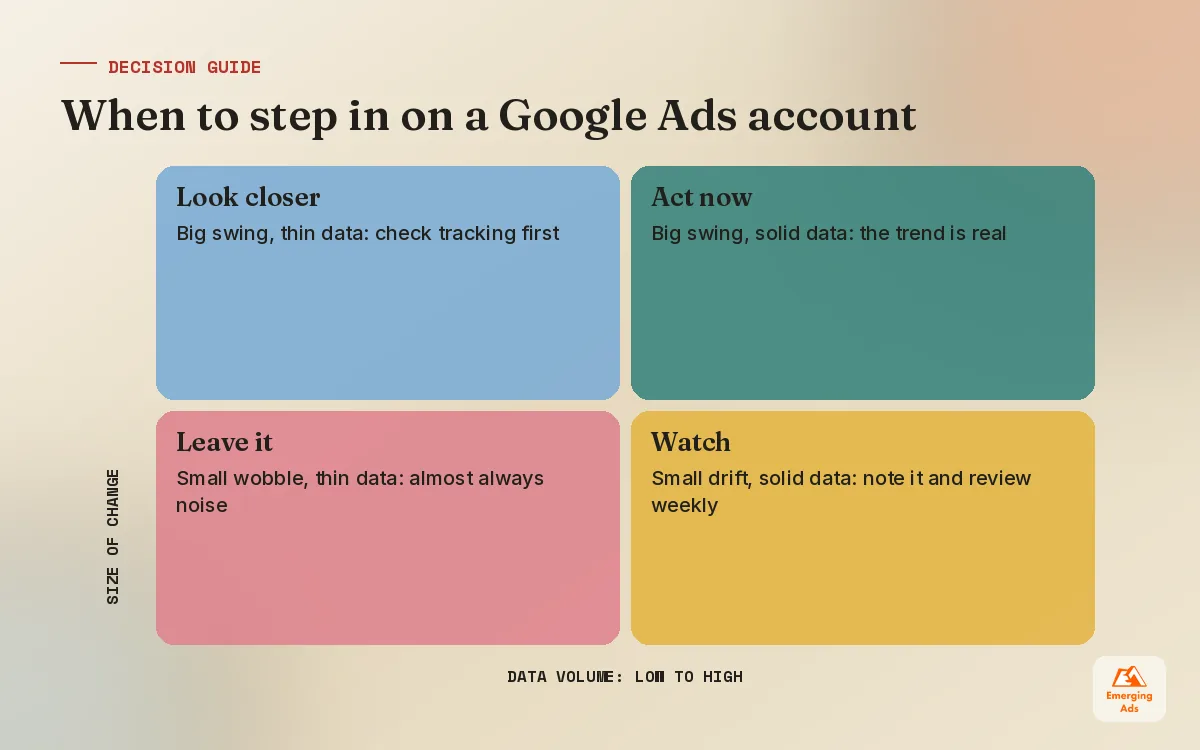
This is the judgement call that separates experienced account managers from anxious ones. Google Ads data is noisy. A single day of poor results is almost always noise. A week can be noise too, especially on smaller accounts. Intervening on noise is how good accounts become bad ones.
Signals that justify stepping in
- Tracking has broken or changed: conversions drop to zero, or suddenly double overnight.
- Spend is pacing far above or below plan for several days without a clear reason.
- Cost per acquisition has drifted well past target over two or more weeks, with enough conversions to trust the trend.
- Search terms show new, irrelevant traffic appearing at scale.
- Something outside the account changed: a new competitor, a price rise, a website update, a stock problem.
Signals that usually mean wait
- One bad day, or a weekend dip on a business that is quiet at weekends.
- A campaign still in its learning period after a recent change.
- A small ad group with a handful of clicks and no conversions yet.
When the data points at the landing page rather than the ads, which is more often than people expect, the fix belongs on the site. We regularly pair account work with landing page design and conversion rate optimisation, because doubling the conversion rate of a page does more than any bid change could.
08In-house, freelancer or agency: who should manage it
There is no single right answer, and we say that as an agency. The best choice depends on spend, complexity and how much internal time you genuinely have. A small local business spending modestly may do well with a trained team member and a quarterly outside review. A business spending seriously across several campaign types usually benefits from specialists who see many accounts and spot patterns early.
| Option | Works best when | Watch out for |
|---|---|---|
| In-house | You have a dedicated person with time and training | Nobody checks their work; blind spots grow |
| Freelancer | Spend is moderate and the account is fairly simple | Single point of failure, limited cover |
| Agency | Spend is significant, or several channels need to work together | Junior staff, long contracts, vanity reporting |
Whoever you choose, ask them to show you their weekly rhythm, their reporting template and how they decide when to intervene. If they cannot answer clearly, the account is being run on instinct. You can see the full range of what we do on our services page, and our main blog has a practical piece on how to choose a digital marketing agency if you are weighing options.
This guide is the first in a series on the EmergingAds HQ PPC blog. Next we look at Performance Max, Meta, LinkedIn and the rest of the paid media mix, each with the same practical, from-the-account approach.
Frequently asked questions
Straight answers to what clients ask us most about google ads management.
What does Google Ads management include?
How often should a Google Ads account be checked?
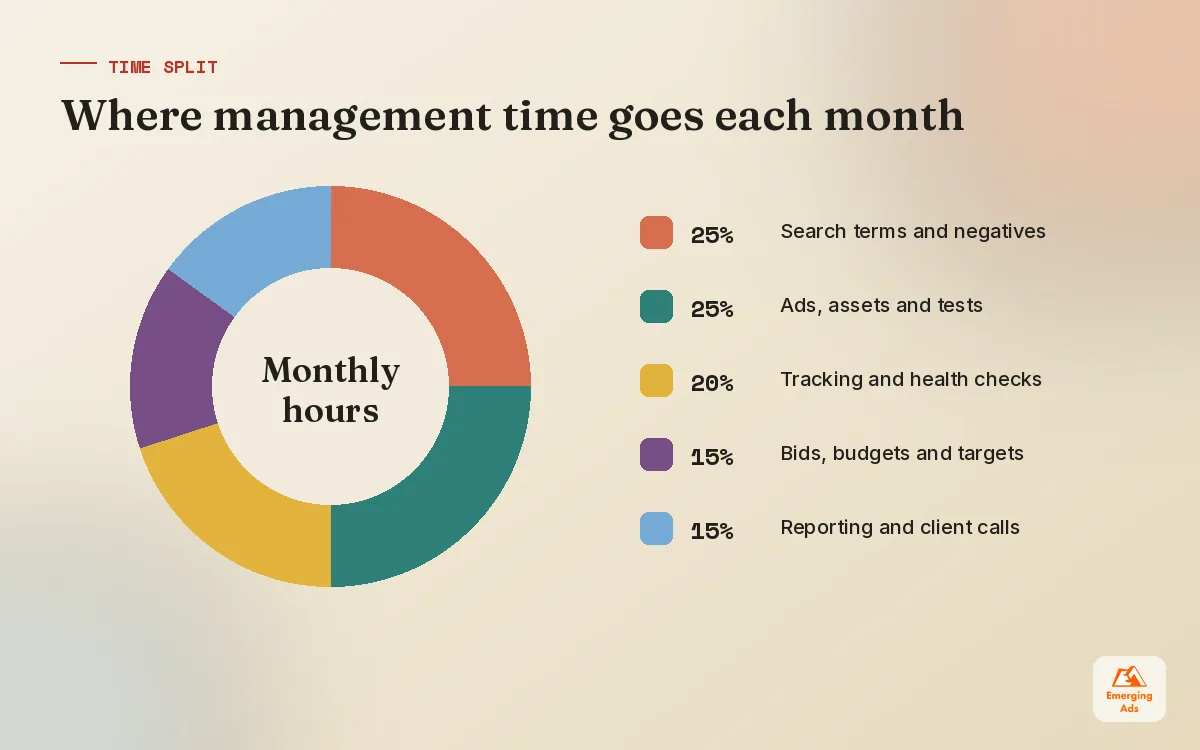
How much time does it take to manage Google Ads properly?
Should I manage Google Ads myself?
What is a good account structure for a small business?
How do I know if my Google Ads manager is doing a good job?
When should I switch to automated bidding?
How often should Google Ads bid targets be changed?
What should a monthly Google Ads report include?
Why do my Google Ads results change so much from week to week?
Is Performance Max enough on its own?
Want a second pair of eyes on how your account is run?
We will review your structure, tracking and weekly routine, then send a short, prioritised list of what to fix first. No jargon, no hard sell.
Book your free audit