Performance Max in 2026: How It Really Spends Your Budget
Performance Max is neither magic nor a black hole. It is a bidding system that spends where your inputs point it. Feed it clean data, sharp assets and honest goals and it can carry an ecommerce account. Feed it guesswork and it will happily spend on your own brand name.
Key takeaways
- Performance Max spends where your inputs point it: goals, feed, assets and signals decide the outcome.
- Structure asset groups around products and margins you would bid differently on, not around creative themes.
- Audience signals are hints to speed up learning, not targeting rules, so do not over-engineer them.
- Protect your brand traffic and read search term insights weekly, or PMax can look better than it is.
- Skip or limit PMax when conversion data is thin, tracking is shaky or you need tight control over queries.
01What Performance Max actually is
Performance Max is a single Google Ads campaign type that can show your ads across Search, Shopping, YouTube, Display, Discover, Gmail and Maps from one budget. You give it a goal, a budget, creative assets, a product feed if you sell online, and some audience hints. Google’s systems then decide where, when and to whom each impression goes. That is the promise, and in the right account it works very well.
The problem is that many businesses treat it as a switch you flip rather than a system you feed. We see it constantly when taking over accounts: one Performance Max campaign, one asset group containing every product, stock photos, a goal that counts newsletter sign-ups as conversions, and no idea how much of the spend is simply buying back people who were already searching for the brand. The campaign looks profitable in the dashboard and the business wonders why revenue has not moved.
If you have not yet read our practical Google Ads management guide, it sets out the account-wide operating rhythm that PMax sits inside. This piece zooms in on the campaign type itself.
02How Performance Max decides where your money goes
Google does not publish the full allocation logic, and anyone who tells you exactly how it works is guessing. What we can describe is what we observe across the accounts we manage, which is consistent enough to plan around.
It follows the cheapest conversions first
Left to itself, the system chases conversions that look easiest to win at your target. That usually means warm traffic: people searching your brand name, returning visitors and shoppers already comparing your products. Those conversions are real, but many would have happened anyway. Cold prospecting on YouTube or Display tends to get a smaller share unless the goal and signals make it worthwhile.
It reflects the quality of each input
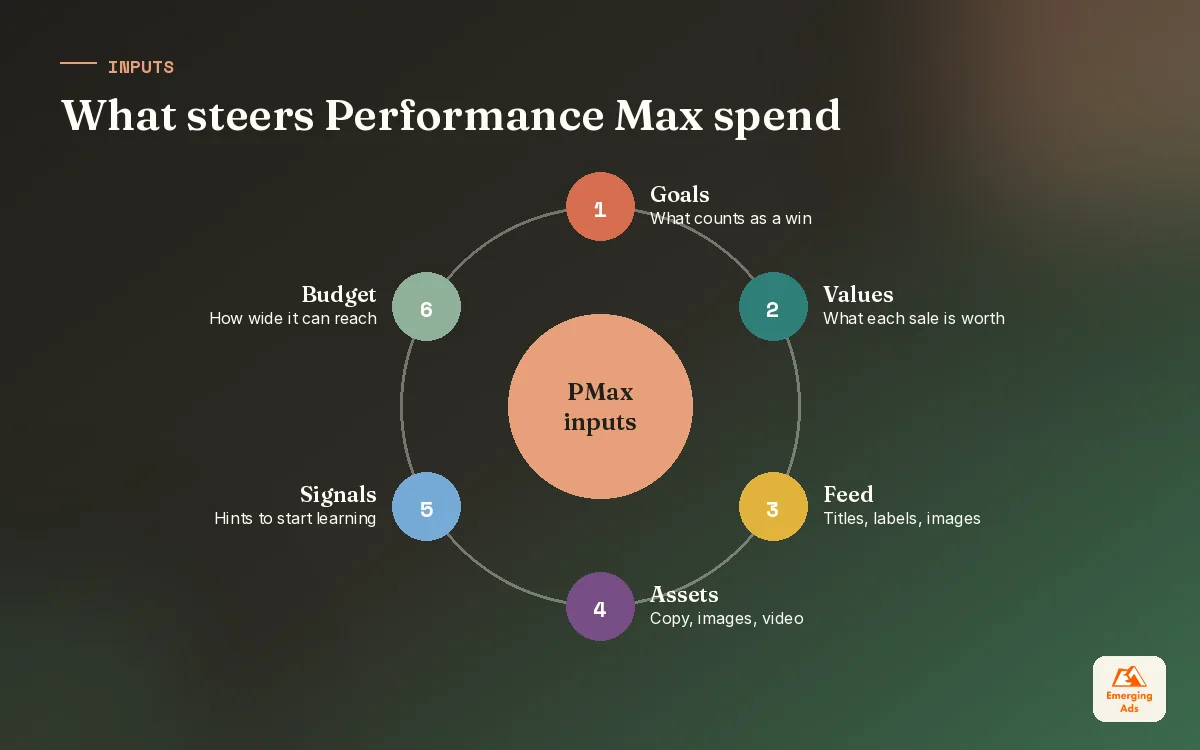
- Feed quality drives how much Shopping inventory you can win. Weak titles and missing attributes limit it.
- Creative assets shape how much video and display reach is realistic. No video, or poor video, limits those placements.
- Conversion goals and values decide what counts as success. Count the wrong thing and the system will find lots of it.
- Budget and target set how wide it can reach. A very tight target with a small budget keeps it close to the warmest traffic.
In practice, most ecommerce Performance Max campaigns we audit put the majority of spend into Shopping-style placements, with the balance spread across other inventory. The exact split varies widely by account, which is why we look at channel reporting and placement data rather than assuming.
03Performance Max asset groups: the structure that matters
Asset groups are where most of the useful control lives. Each asset group holds a set of creative assets, optional audience signals and, for retailers, a listing group that decides which products it can show. How you split them decides how precisely you can steer budget.
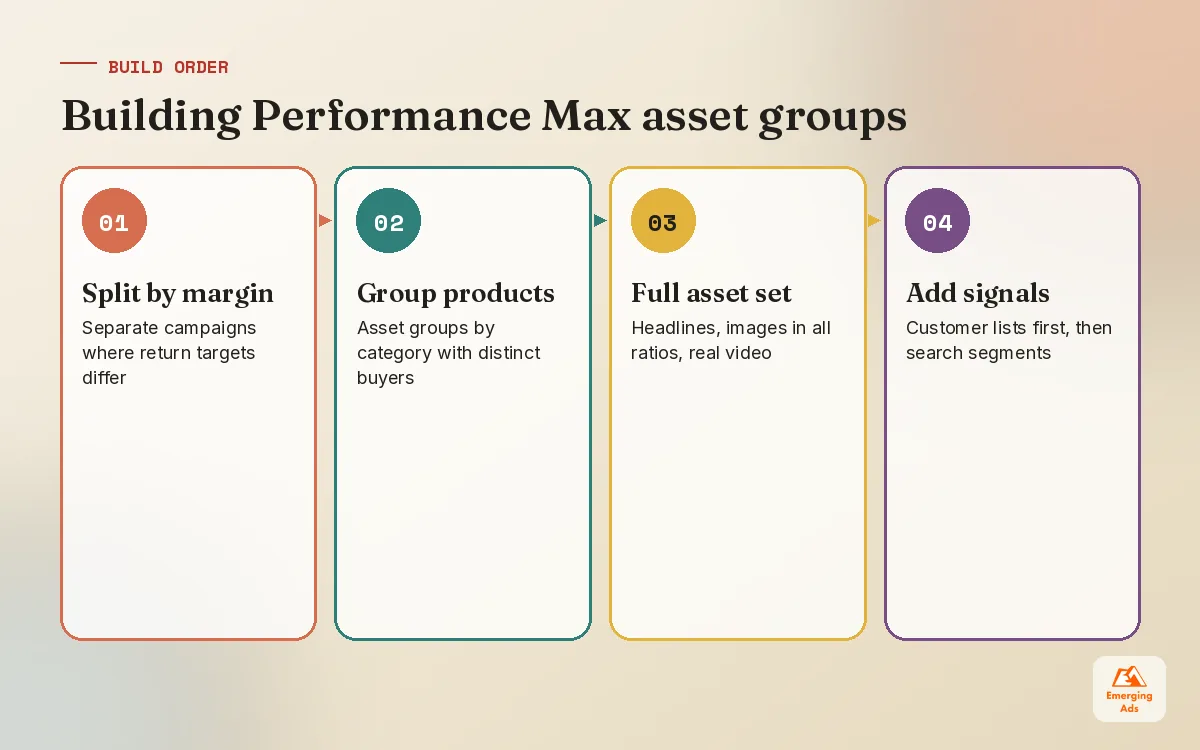
Split by how you would bid, not by how the ads look
A common mistake is creating asset groups by creative theme: summer images in one, lifestyle shots in another. Structurally that does very little. We prefer to split by things that change the economics. A homeware retailer we work with has one campaign for its high-margin own-brand range and another for branded third-party products with thin margins, each with a different return target. Inside each, asset groups follow product categories with genuinely different buyers.
| Split approach | When it works | When it hurts |
|---|---|---|
| By margin band (separate campaigns) | Margins differ a lot across the catalogue | Catalogue is small and margins are similar |
| By product category (asset groups) | Categories attract different buyers and need different creative | Too many groups spread thin data |
| By best sellers vs long tail | A few products drive most revenue and hog spend | You split before you have data to judge |
| By creative theme only | Rarely worth it on its own | Adds complexity without changing budget flow |
Give every asset group a full set of assets
Each asset group should have the full range of headlines, long headlines, descriptions, images in several ratios, logos and, ideally, real video. If you leave video out, Google may generate something from your images, and in our experience those auto-made clips rarely represent a brand well. Short, simple vertical and horizontal videos shot on a phone usually beat them. If creative is the bottleneck, our team handles video content production specifically for ad placements.
04Audience signals: hints, not targeting
This is the most misunderstood part of Performance Max. Audience signals do not restrict who sees your ads. They tell the system where to start looking, and it is free to go well beyond them once it finds people who convert. So the goal is not to build a perfect audience. It is to give a strong starting point.
What we put in, in order of usefulness
- Your own customer data. Customer lists and website visitors, especially past purchasers. This is usually the strongest signal because it is real.
- Custom segments from search behaviour. The terms your best customers search, and competitor or category terms that show clear intent.
- Interests and life events. Useful for broad categories, weaker for niche products.
We keep signals focused on each asset group’s buyer rather than stuffing every audience into every group. Then we let the data speak. If an asset group’s insights show conversions coming from audiences we never supplied, that is the system doing its job, not a mistake.
05Your product feed is your real ad copy
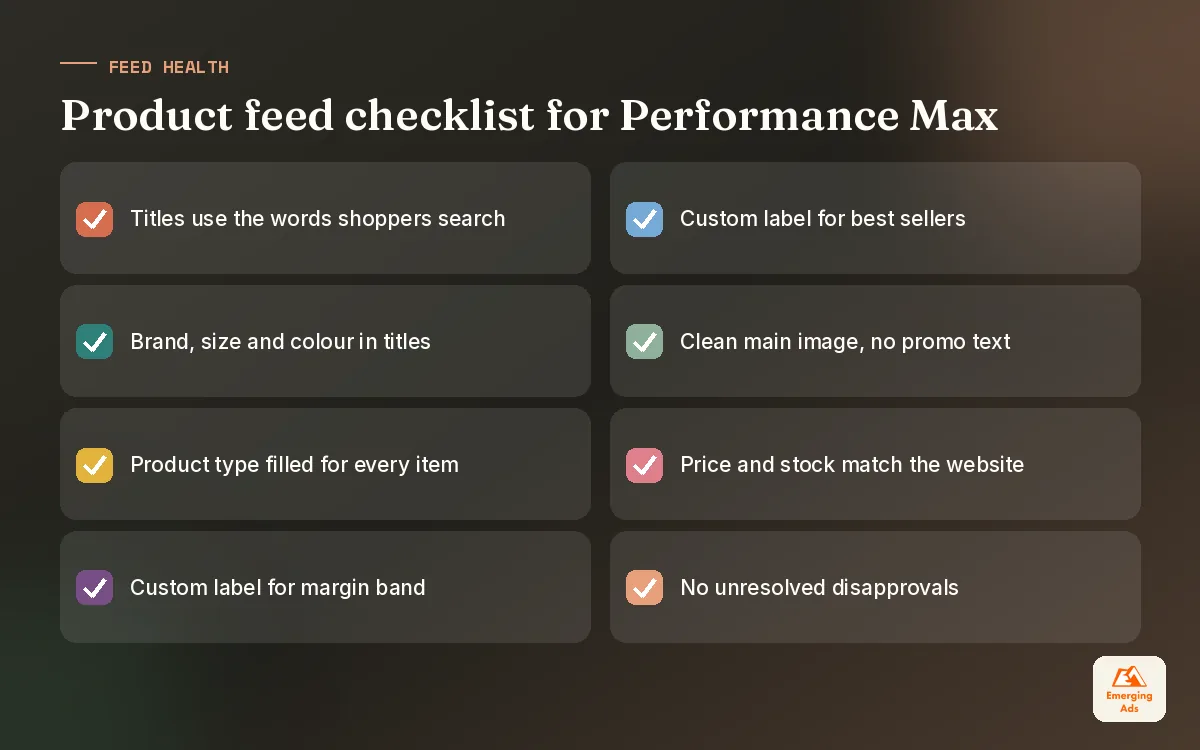
For retailers, the Merchant Center feed shapes Performance Max more than any other input. Titles work much like keywords. Product types and custom labels decide how finely you can structure listing groups. Images decide whether anyone clicks. A tidy feed is the single highest-return piece of work in most ecommerce accounts we take on.
| Feed element | What good looks like | Common problem we fix |
|---|---|---|
| Title | Brand, product type, key attribute, size or colour, in the words shoppers use | Internal product codes or vague marketing names |
| Product type | A clear category path you can segment on | Blank or one generic value for everything |
| Custom labels | Margin band, best seller flag, season, stock depth | Unused, so every product is treated the same |
| Images | Clean main image, plus lifestyle shots as additional images | Low resolution, watermarks, promotional text |
| Price and availability | Always matching the site | Mismatches that trigger disapprovals |
Custom labels deserve a special mention. Once each product carries a margin band and a best seller flag, you can split listing groups and campaigns by the things that actually matter to profit. Our Google Shopping ads service covers this feed work in depth, and for Shopify stores we often handle it as part of broader Shopify ecommerce marketing.
06Brand exclusions, search term insights and keeping control
The biggest criticism of Performance Max is lost control. Some of that is fair. But there are more levers than most people use, and pulling them turns a black box into something you can reason about.
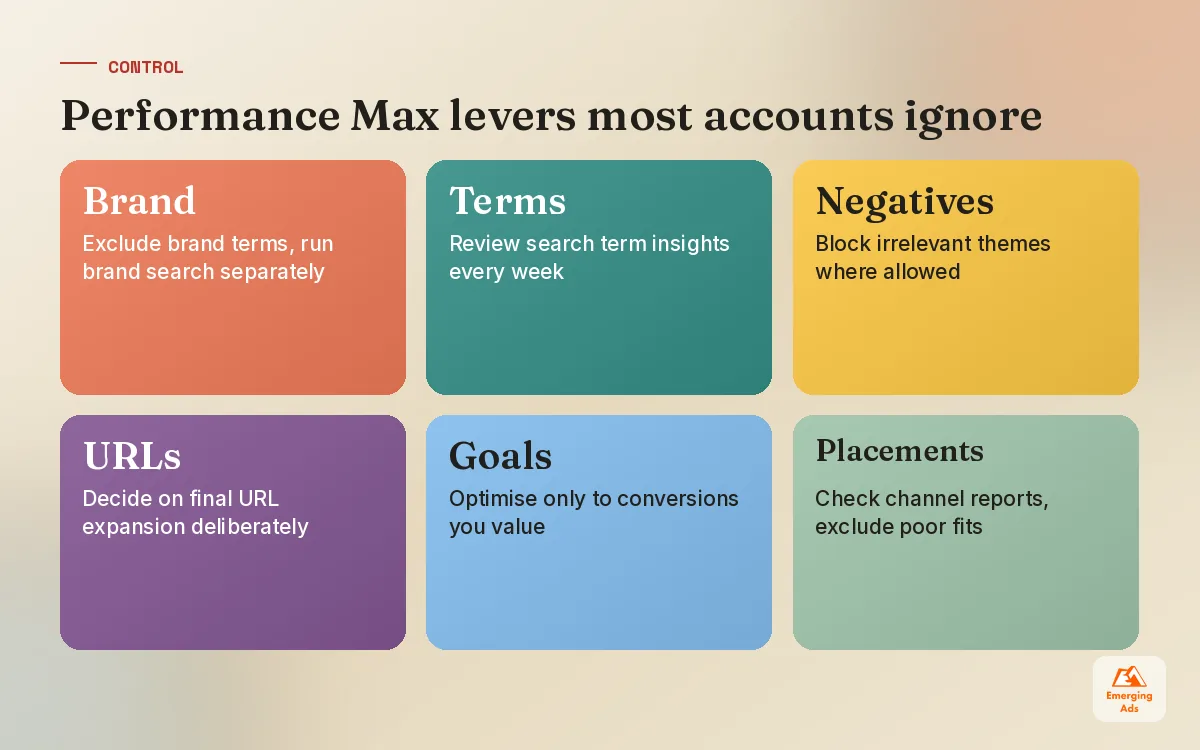
Protect your brand traffic
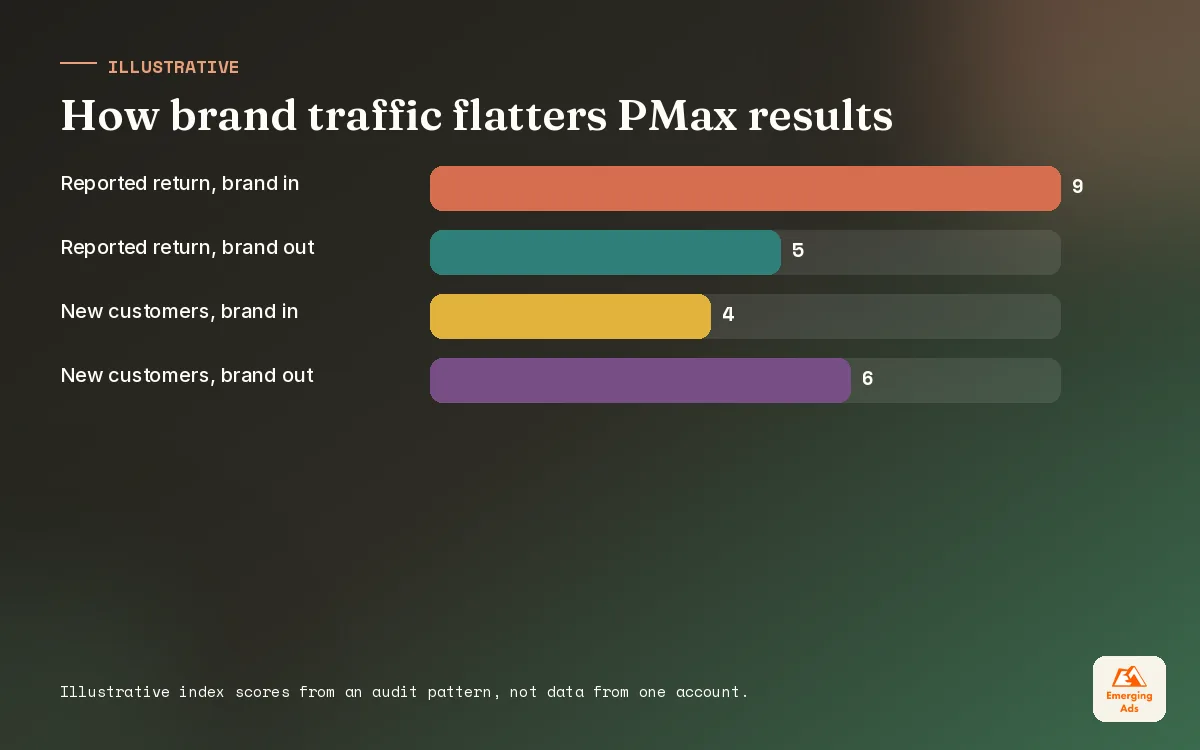
Without guardrails, Performance Max can pick up a large share of searches for your own brand name. Those clicks are cheap and convert well, which flatters the campaign’s figures. We usually run a separate brand Search campaign and apply brand exclusions to Performance Max, so we can see how much genuinely new demand it creates. The first time a client sees their PMax results with brand traffic separated out is often a sobering moment, and a useful one.
Read search term insights every week
Search term insights and the search reporting available for Performance Max show which themes and queries are triggering your ads. We review them weekly alongside the account’s Search campaigns. Irrelevant themes become negative keywords where the platform allows, and high-value themes that PMax is winning often earn their own Search ad group with tailored copy. Running Performance Max alongside well-managed Google Search campaigns gives you both reach and control.
Other levers worth knowing
- Final URL expansion: decide deliberately whether PMax may send traffic to pages you did not choose. We often restrict it for lead generation sites.
- Customer acquisition goals: useful when new customers matter more than repeat buyers, as long as your customer lists are current.
- Placement and channel reporting: check where impressions actually go, and exclude placements that clearly do not fit.
- Conversion goal settings: make sure the campaign only optimises towards conversions you would happily pay for.
07Measuring Performance Max honestly
Performance Max reports its own results inside Google Ads, and like any platform it takes generous credit. We never judge it on in-platform return alone. Instead we look at three layers together.
- In-platform results with brand separated. What PMax delivers once brand search is excluded or reported apart.
- Blended business results. Total revenue, new customers and marketing efficiency across all channels, week by week.
- Holdout or geo tests where spend allows. Pausing or reducing PMax in a region and watching what happens to total sales is the most honest test there is.
Clean attribution modelling helps, but no model replaces watching the bank balance. If total revenue does not move when PMax spend grows, the campaign is likely taking credit rather than creating demand.
Performance Max is only as smart as the goal you give it. Tell it the truth about what a sale is worth and it gets much smarter.
08When not to use Performance Max
We run Performance Max in many accounts, but we also switch it off or never launch it in plenty of others. It is a tool, not a default.
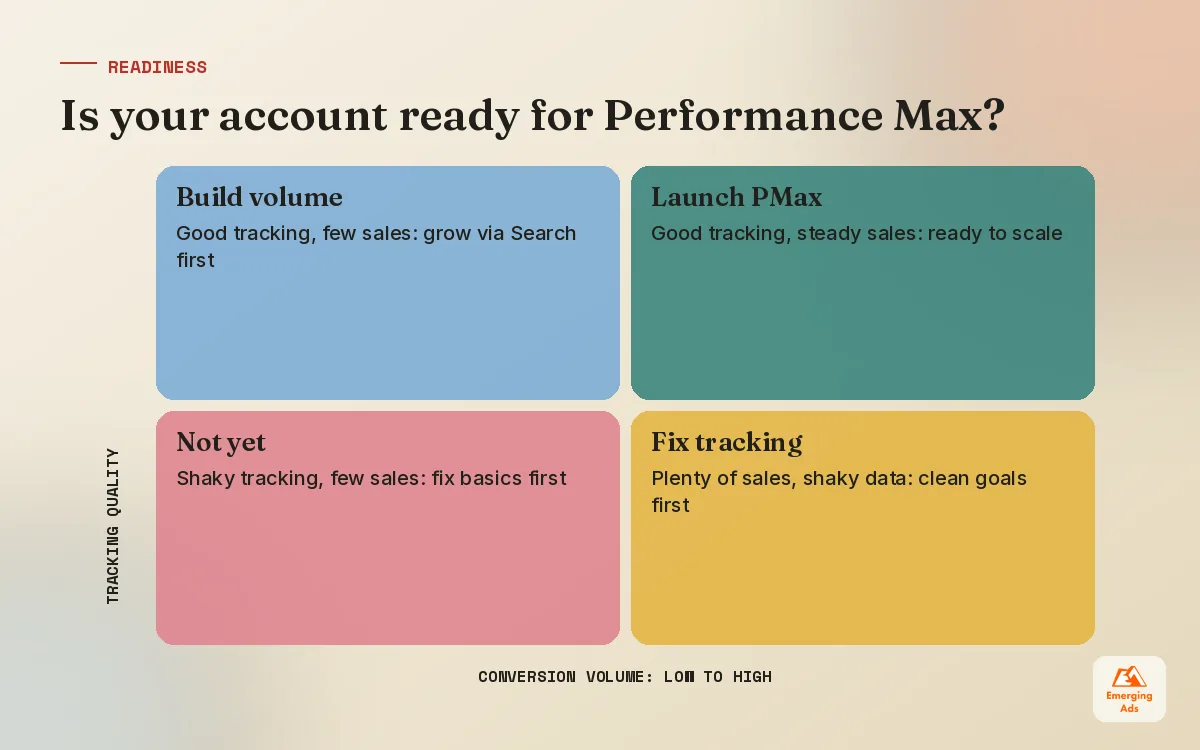
- Conversion tracking is shaky. If conversions are double counted or values are wrong, PMax will optimise enthusiastically towards the wrong thing. Sort out your conversion tracking before anything else.
- Conversion volume is very low. With only a trickle of conversions, the system has little to learn from and spend can wander.
- Lead generation with poor lead quality feedback. PMax can find cheap form fills that sales never closes. Without offline conversion data feeding back, it cannot tell good leads from bad.
- You need tight query control. Regulated industries, or businesses where the wrong search term is genuinely costly, are usually better served by Search first.
- No usable creative. Without decent images and video, PMax leans on its weakest placements.
In those cases we usually build Search and standard Shopping first, fix tracking, and bring PMax in later. For awareness-led video work, Demand Gen campaigns often give more control over audiences and creative than PMax does.
If you want a team that runs this every day, our Performance Max management service is built around the approach in this guide, and it usually sits within wider ecommerce marketing work that includes Meta and email. You will find more practical guides like this on the EmergingAds HQ blog.
Frequently asked questions
Straight answers to what clients ask us most about performance max.
What is Performance Max in Google Ads?
Is Performance Max good for small businesses?
How many asset groups should a Performance Max campaign have?
Do audience signals limit who sees my Performance Max ads?
Should I exclude my brand from Performance Max?
Can I see search terms in Performance Max?
Performance Max vs standard Shopping: which is better?
How long does Performance Max take to learn?
Why is my Performance Max campaign spending but not converting?
Does Performance Max work for lead generation?
How much budget does Performance Max need?
Is Performance Max quietly spending on the wrong things?
We will look at your asset groups, feed, brand traffic and search term insights, then show you where the budget is really going and what to change first.
Book your free audit